
t’s the #1 cause of obesity in the US.
But we’re now finding out the that it’s also closely related to the rise in cancer.
In this article by Dr. Mercola we’ll look at how cancer and other chronic disease is through mitochondrial dysfunction.
You’ll also discover why this specific syrup is a primary culprit in cancer.
And Dr. Mercola explains why intermittent fasting is so effective for reversing insulin resistance, reducing your risk of cancer, and increasing longevity.
Finally, you’ll learn the important changes you need to start making today to protect yourself and your family.
Sugar (and Obesity) Responsible for 500,000 Cases of Cancer Each Year
According to the Credit Suisse Research Institute’s 2013 study1“Sugar: Consumption at a Crossroads,” as much as 40 percent of US healthcare expenditures are for diseases directly related to the overconsumption of sugar.
Incredibly, we spend more than $1 trillion each year fighting the damaging health effects of sugar, which runs the gamut from obesity and diabetes, to heart disease and cancer.
The fact that sugar and obesity are linked to an increased risk of cancer is now becoming well-recognized. According to a report2 on the global cancer burden, published in 2014, obesity is responsible for an estimated 500,000 cancer cases worldwide each year.
Nearly two-thirds of obesity-related cancers — which include colon, rectum, ovary, and womb cancers — occur in North America and Europe.3 A more recent British report estimates obesity may result in an additional 670,000 cancer cases in the UK alone over the next 20 years.
According to BBC News,4 the Cancer Research UK and the UK Health Forum report are calling for a ban on junk food ads aired before 9pm to address out of control rise in obesity and obesity-related diseases.
Meanwhile, a German investigation into diet-induced diseases and related treatment costs reveal that sugar-induced oral disease represents the greatest chunk of that nation’s health care costs.
As noted by the Dental Tribune:5
“… [T]he substantial impact of sugar consumption found in the study was mainly due to the costs of treating caries and other diseases of the hard tissue of teeth, hypertensive and cardiovascular diseases, diabetes mellitus, rectal and colon cancer, as well as chronic kidney disease.”
How Excess Sugar and Obesity Promotes Cancer
One of the key mechanisms by which sugar promotes cancer and other chronic disease is through mitochondrial dysfunction.
Since sugar is not our ideal fuel, it burns dirty with far more reactive oxygen species than fat, which generates far more free radicals which in turn causes mitochondrial and nuclear DNA damage along with cell membrane and protein impairment.
Research6 has also shown that chronic overeating in general has a similar effect. Most people who overeat also tend to eat a lot of sugar-laden foods — a double-whammy in terms of cancer risk.
Chronic overeating places stress on the endoplasmic reticulum (ER), the membranous network found inside the mitochondria of your cells. When the ER receives more nutrients than it can process, it signals the cell to dampen the sensitivity of the insulin receptors on the surface of the cell.
Thus continuously eating more than your body really needs promotes insulin resistance by the mere fact that your cells are stressed by the work placed on them by the excess nutrients. Insulin resistance in turn is at the heart of most chronic disease, including cancer.
High-Fructose Corn Syrup Primary Culprit in Cancer

This also helps explain why intermittent fasting (as well as other forms of calorie restriction) is so effective for reversing insulin resistance, reducing your risk of cancer, and increasing longevity.
Obesity, caused by a combination of eating too much refined fructose/sugar and rarely if ever fasting, may also promote cancer via other mechanisms, including chronic inflammation and elevated production of certain hormones, such as estrogen, which is associated with an increased risk for breast cancer.
According to recent research,7,8 from the University of Texas MD Anderson Cancer Center, refined sugar not only significantly increases your risk of breast cancer, it also raises your risk of tumors spreading to other organs.
Moreover, this study found that it was primarily the refined fructose in high-fructose corn syrup, found in most processed foods and beverages that was responsible for the breast tumors and the metastasis.
Without Sugar, Cancer Cannot Thrive
One of the most powerful strategies I know of to avoid and/or treat cancer is to starve the cancer cells by depriving them of their food source, which is primarily sugar and excessive protein.
Unlike all the other cells in your body, which can burn carbs or fat for fuel, cancer cells have lost that metabolic flexibility and can onlythrive if there enough sugar present.
German cancer researcher Dr. Otto Warburg was actually given a Nobel Prize in 1931 for discovering this. Sadly very few experts have embraced his metabolic theory of cancer, but have embraced the nuclear genetic theory that is a downstream side effect of mitochondrial dysfunction.
Make no mistake about it, the FIRST thing you want to do if you want to avoid or treat cancer if you have insulin or leptin resistance (which 85 percent of people do) is to cut out all forms of sugar/fructose and grain carbs from your diet, in order to optimize the signaling pathways that contribute to malignant transformation.
Reduce Your Fructose and Non-Fiber Carb Intake

I recommend reducing your total fructose intake to a maximum of 25 grams/day, from all sources, including fruit. If you are insulin resistant, you’d do well to make your upper limit 15 grams/day.
Cancer patients would likely be best served by even stricter limits. For a more detailed discussion please review my interview with Professor Thomas Seyfried, who is one of the leading cancer pioneer researchers in promoting how to treat cancer nutritionally. I personally believe that most would benefit from reducing all non-fiber carbs (total carbs minus fiber), not just fructose, to less than 100 grams per day.
I typically keep mine around 50 to 60 grams every day.
The easiest way to dramatically cut down on your sugar and fructose consumption is to switch to REAL foods, as most of the added sugar you end up with comes from processed fare, not from adding a teaspoon of sugar to your tea or coffee. But there are other ways to cut down well. This includes:
- Cutting back on the amount of sugar you personally add to your food and drink
- Using stevia or luo han instead of sugar and/or artificial sweeteners. You can learn more about the best and worst of sugar substitutes in my previous article, “Sugar Substitutes — What’s Safe and What’s Not“
- Using fresh fruit in lieu of canned fruit or sugar for meals or recipes calling for a bit of sweetness
- Using spices instead of sugar to add flavor to your meal
Signs of Progress, But Dietary Guidelines Are Still Flawed
The excess consumption of sugar in the U.S. can be directly traced to flawed dietary guidelines and misplaced agricultural subsidies. Progress is being made however, with the 2015 to 2020 U.S. dietary guidelines9 now recommending limiting your sugar intake to a maximum of 10 percent of your daily calories.10 Google Trends11also reveal that more people are now concerned with low-sugar diets than low-fat diets.
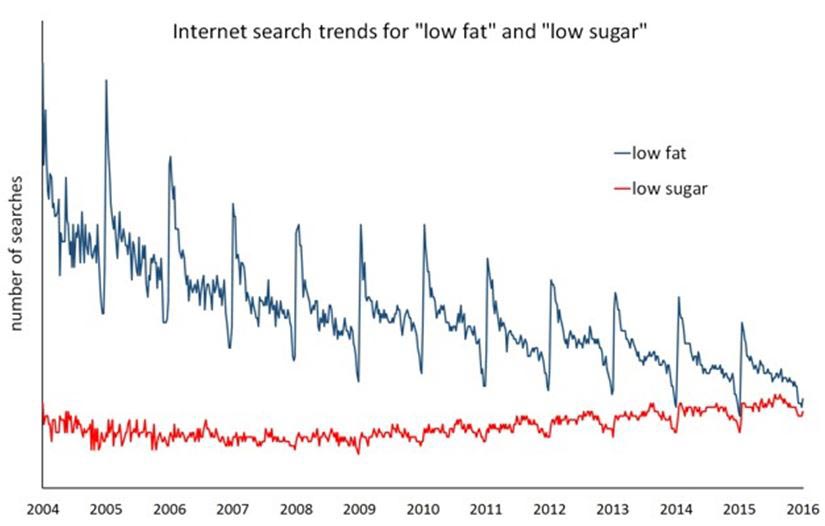
Unfortunately, the dietary guidelines still suggest limiting saturated fat to 10 percent of calories, which is likely far too low for most people. Tragically, it also makes no distinction between healthy saturated fats and decidedly unhealthy trans fats. Saturated fats are actually very important for optimal health, and those with insulin/leptin resistance may need upwards of 50 to 80 percent of their daily calories from healthy fat.
Trans fats, on the other hand, have no redeeming health value, and the evidence suggests there’s no safe limit for trans fats. Besides that glaring flaw, the conundrum with the new guidelines is that both sugar and fat should be limited to 10 percent each of daily calories.
This completely ignores the fact that as you cut out sugar (carbs), you need to replace that lost energy with something else, and that something else is healthy fat, such as that found in avocado, organic seeds and nuts, raw organic butter, cheese, and coconut oil, just to name a few.
They do get a number of things right though. In addition to the recommendation to limit sugar, the limits for dietary cholesterol have been removed, giving the thumbs up for eggs and other cholesterol-rich foods. They also note that most Americans need to reduce the amount of red meat consumed.
As I’ve discussed before, the risks of eating too much proteininclude an increased risk for cancer, as it can have a stimulating effect on the mTOR pathway, which plays an important role in many diseases, including cancer.
When you reduce protein to just what your body needs, mTOR remains inhibited, which helps minimize your chances of cancer growth. As a general rule, I recommend limiting your protein to one-half gram of protein per pound of lean body mass, which for most people amounts to 40 to 70 grams of protein a day.
U.S. Government Has Long Encouraged Sugar Consumption

With one food — sugar — causing such pervasive health problems and so much national expense (again, about $1 trillion per year!), U.S. regulators would do well by encouraging lower sugar consumption. Yet they don’t. The new dietary guidelines are one step in the right direction, but to really get to the root of the obesity problem, they also need to rethink sugar and corn subsidies.12
Current farm subsidies bring you high-fructose corn syrup (HFCS), fast food, junk food, corn-fed beef from concentrated animal feeding operations (CAFOs), monoculture, and a host of other contributors to our unhealthy contemporary diet. Both the sugar and corn industry (from which you get high fructose corn syrup) are heavily subsidized by taxpayers. Moreover, as noted by The Washington Post last year:13
“The [sugar] industry used to boast that its government protection does not cost taxpayers anything directly, but that claim has been exploded due to recent market developments that forced the federal government to, in effect, buy up tons and tons of sugar and sell it to ethanol refiners at a loss — so as to prop up prices. Taxpayers took a hit of some $258 million in fiscal 2014.”
Billions of dollars go to corn farmers who have driven down the price of corn so deeply that HFCS is now the number one source of calories in the standard American diet, simply because it’s so cheap. Meanwhile, very few farm subsidies are being doled out to the farmers who grow your produce.
Between 1995 and 2012, the amount gifted to corn growers was $84,427,099,356. Compare this with the amount that went to apple growers: $242,064,005.14 In a 2012 report entitled “Apples to Twinkies,” it was determined that each year your tax dollars (in the form of subsidies) would allow you to buy 19 Twinkies but less than a quarter of one red delicious apple.
There can be little doubt that the U.S. government’s decision to subsidize junk food ingredients rather than real food, such as fresh produce, plays a major role in American’s eating habits, since people will typically eat that which is available and that which they can afford.
At present, most Americans spend upwards of 90 percent of their food budgets on processed foods, which are typically loaded with added sugars/fructose, and offer little in terms of nutritional value. Obesity is a result of such eating habits, and making real food more readily available at lower prices could go a long way toward reversing this trend.
Study: Reducing Sugar Content and Taxing Soda May Greatly Reduce Obesity

The suggestion of a soda tax has been flouted for a number of years now, both in the U.S. and Great Britain,15 and elsewhere. The vast majority have failed due to intensive lobbying and local anti-tax campaigns by the sugar industry. It did succeed in one place however. In Mexico, where a 10 percent tax on sugary beverages was enacted as of January 1, 2014, sales of such beverages shrunk by 12 percent in one year.16 As reported by Newsweek,17
“The decline in consumption was greatest amongst those who earned the least, and appears to be going up over time as people’s habits change … Frank Chaloupka, an economist at the University of Illinois at Chicago who wasn’t involved in the study, says that the tax ought to be applied elsewhere, and would improve health by encouraging a lower consumption of sugar.
‘I think sugary beverage taxes should be an important part of a comprehensive approach to promoting healthier diets and reducing obesity,’ he says. ‘The experiences in Mexico are demonstrating their effectiveness in altering consumer behavior, which will almost certainly eventually show up” as a decline in obesity, he adds.'”
Other investigations suggest simply lowering the sugar content of sodas may do the trick. A British study,18 which assessed the potential health benefits of gradually lowering sugar content in beverages over a 5-year period, suggests such a strategy might prevent 1 million cases of obesity over 20 years.
While the impact on any given individual would be quite small, reducing the average person’s calorie consumption by a mere 38 calories a day by the end of the 5th year (equating to a weight lossof just 1.2 pounds), the grand societal effect could still be pronounced.
By reducing people’s weight even slightly, an estimated 274,000 to 309,000 cases of type 2 diabetes could be prevented over the following two decades. Still, when you consider that the sugar and corn industries are fighting to receive the largest subsidies and market share to give you cancer, it would make sense to stop subsidizing sugar and corn before you start taxing sugary products.
Cancer screening is conventionally touted as being an important part of “cancer prevention,” even though it does no such thing. Now, researchers question the validity of public service announcements claiming that “cancer screening saves lives.” According to a recent analysis,19 it’s “unclear” whether screening actually saves lives, and the researchers warn that claiming it does is “misleading.”
As reported by Newsweek:20
“The problem, they say, is that the ubiquitous adage is based on the fact that deaths from the target disease may decline but fails to take into account deaths linked to factors related to the screening itself. Sure, screening for prostate cancer might reduce the incidence of death from that specific disease, but does it reduce overall mortality for the person who got the screening? Maybe not.
For example, prostate cancer screening is known to return ‘numerous’ false positives … and contributes to over 1 million prostate biopsies a year. The procedure is ‘associated with serious harms, including admission to hospital and death.’ What’s more, men diagnosed with prostate cancer are ‘more likely to have a heart attack or commit suicide in the year after diagnosis’ … In both cases, the deaths aren’t due to the cancer itself but rather are linked to the screening.”
The same goes for breast cancer screening and colorectal cancer screening:
- 60 percent of women who undergo regular mammography screening for 10 years receive a false positive at some point, leading to unnecessary distress and treatment, which can have serious side effects. Studies have also shown that routine mammograms have no effect on death rates.As noted by Reuters:21
“[T]hese tests avert just 1 breast cancer death for every 1,000 women screened. ‘There used to be ads saying if a woman hadn’t had a mammogram, she needed more than her breasts examined,’ Prasad said. ‘The fact that the medical profession promoted screening so strongly, when it was always a balancing act, when it was always a personal choice, is really shameful.'”
- A study22 looking at colorectal cancer screening found 128 cancer deaths among every 10,000 people who received screening, compared to 192 cancer deaths among every 10,000 individuals who didn’t get screened.
While there were fewer cancer deaths among those screened, this link completely disappeared when they looked at all-cause mortality. When death from all causes was included, there was no meaningful difference between the two groups.
It’s Time to Change the Discussion About Cancer Screening
According to the authors, in order to determine whether cancer screening truly saves lives, “statistically robust studies based on millions of people are needed.” This would be a costly venture, they admit, “but no more so than supporting mass population screening programs with unproven benefits.”
In an accompanying editorial,23 Gerd Gigerenzer, director of the Max Planck Institute for Human Development notes that:
“Rather than pouring resources into ‘megatrials’ with a small chance of detecting a minimal overall mortality reduction, at the additional cost of harming large numbers of patients, we should invest in transparent information in the first place. It is time to change communication about cancer screening from dodgy persuasion into something straightforward.”
To do so, she suggests patients should be given pamphlets with fact boxes that clearly present the available data, such as the Risk Literacy fact sheet for mammography below,24 which shows that while mammograms reduce cancer specific mortality in 1 out of 1,000 women, this difference is not reflected in overall mortality.
And, that as many as 10 women out of 1,000 women screened will undergo unnecessary breast removal as a result of a false positive.
Presented with such data, patients would be better able to make a personal decision about whether or not screening in their particular instance might be worth the risk. She also notes that while some may benefit from screening, doctors should not overstate the value of the tests. In an email to Reuters, Gigerenzer says:
“The take-home message is after decades of research we have not found clear evidence that screening saves lives, but clear evidence that screening harms many.”

Cancer screening is portrayed as the best form of “prevention” you can get against various forms of cancer. But early diagnosis is notthe same as prevention. And cancer screening that does more harm than good can hardly qualify as the best you can hope for … I believe the vast majority of all cancers could be prevented by strictly applying basic, common-sense healthy lifestyle strategies, which includes the following:
| Eat REAL food; avoid processed foods and sugars, especially processed fructose | All forms of sugar are detrimental to health in general and promote cancer. Fructose, however, is clearly one of the most harmful and should be avoided as much as possible.
Reduce non-fiber carbs but have large volumes of fresh organic veggies along with loads of fat from high quality sources such as avocados, raw butter, seeds, nuts, and raw cacao nibs.
|
| Stop eating AT LEAST three hours before going to bed | There is quite compelling evidence showing that when you supply fuel to the mitochondria in your cells at a time when they don’t need it, they will leak a large number of electrons that will liberate reactive oxygen species (free radicals), which damage mitochondrial and eventually nuclear DNA.
There is also evidence to indicate that cancer cells uniformly have damaged mitochondria, so the last thing you want to do is eat before you go to bed. Personally I strive for 6 hours of fasting before bedtime.
|
| Optimize your vitamin D | Vitamin D influences virtually every cell in your body and is one of nature’s most potent cancer fighters. Vitamin D is actually able to enter cancer cells and trigger apoptosis (cell death).
If you have cancer, your vitamin D level should be between 70 to 100 ng/ml. Vitamin D works synergistically with every cancer treatment I’m aware of, with no adverse effects.
|
| Limit your protein | Newer research has emphasized the importance of the mTOR pathways. When these are active, cancer growth is accelerated.
To quiet this pathway, I believe it may be wise to limit your protein to one gram of protein per kilogram of lean body mass, or roughly a bit less than half a gram of protein per every pound of lean body weight.
That is roughly 40 to 70 grams per day for most. It would be unusual for most to need more than this.
|
| Avoid unfermented soy products | Unfermented soy is high in plant estrogens, or phytoestrogens, also known as isoflavones. In some studies, soy appears to work in concert with human estrogen to increase breast cell proliferation, which increases the chances for mutations and cancerous cells. |
| Improve your insulin and leptin receptor sensitivity | The best way to do this is by avoiding sugar and grains and restricting non-fiber carbs to to under 100 grams per day. Also making sure you are exercising, especially with high-intensity interval training. |
| Exercise regularly | One of the primary reasons exercise works to lower your cancer risk is because it drives your insulin levels down, and controlling your insulin levels is one of the most powerful ways to reduce your cancer risks.
It’s also been suggested that apoptosis (programmed cell death) is triggered by exercise, causing cancer cells to die.
Studies have also found that the number of tumors decrease along with body fat, which may be an additional factor.
This is because exercise helps lower your estrogen levels, which explains why exercise appears to be particularly potent against breast cancer.
Finally, exercise increases mitochondrial biogenesis, which is essential to fight cancer.
|
| Maintain a healthy body weight | This will come naturally when you begin eating right for your nutritional type and exercising. It’s important to lose excess body fat because fat produces estrogen. |
| Drink a pint to a quart of organic green vegetable juice daily | Please review my juicing instructions for more detailed information. |
| Get plenty of high quality animal-based omega-3 fats, such as krill oil | Omega-3 deficiency is a common underlying factor for cancer. |
| Use curcumin | This is the active ingredient in turmeric and in high concentrations can be very useful adjunct in the treatment of cancer.
For example, it has demonstrated major therapeutic potential in preventing breast cancer metastasis.25
It’s important to know that curcumin is generally not absorbed that well, so I’ve provided several absorption tips here.
|
| Avoid drinking alcohol | At minimum, limit your alcoholic drinks to one per day. |
| Avoid electromagnetic fields as much as possible | Even electric blankets can increase your cancer risk. |
| Avoid synthetic hormone replacement therapy, especially if you have risk factors for breast cancer | Breast cancer is an estrogen-related cancer, and according to a study published in the Journal of the National Cancer Institute, breast cancer rates for women dropped in tandem with decreased use of hormone replacement therapy.
(There are similar risks for younger women who use oral contraceptives. Birth control pills, which are also comprised of synthetic hormones, have been linked to cervical and breast cancers.)
If you are experiencing excessive menopausal symptoms, you may want to consider bioidentical hormone replacement therapy instead, which uses hormones that are molecularly identical to the ones your body produces and do not wreak havoc on your system. This is a much safer alternative.
|
| Avoid BPA, phthalates and other xenoestrogens | These are estrogen-like compounds that have been linked to increased breast cancer risk. |
| Make sure you’re not iodine deficient | There’s compelling evidence linking iodine deficiency with certain forms of cancer. Dr. David Brownstein,26 author of the book “Iodine: Why You Need it, Why You Can’t Live Without it,” is a proponent of iodine for breast cancer.
It actually has potent anticancer properties and has been shown to cause cell death in breast and thyroid cancer cells.
For more information, I recommend reading Dr. Brownstein’s book. I have been researching iodine for some time ever since I interviewed Dr. Brownstein as I do believe that the bulk of what he states is spot on.
However, I am not convinced that his dosage recommendations are ideal. I believe they are 5 to 6 times higher than optimal.
|
| Avoid charring your meats | Charcoal or flame broiled meat is linked with increased breast cancer risk. Acrylamide — a carcinogen created when starchy foods are baked, roasted or fried — has been found to increase cancer risk as well. |
Thanks for taking the time to read this article. If you found this information helpful, please share it with your friends and family. Your support in our endeavor of sharing free information would be much appreciated.
Follow us on Facebook to stay updated with what's going Viral in the Alternative News scene. https://www.facebook.com/ViralAlternativeNews
http://wisemindhealthybody.com


